Hot model problem in climate science
#ClimateScience #ClimateChange #ClimateModels
🔗 https://mstdn.social/@ecosdelfuturo/111840921812537887
This video by #SabineHossenfelder does a very good job explaining the so-called hot model problem in climate science.
However, I think Sabine makes the mistake of coming to too firm a conclusion on an issue that is still far from clear and is under heavy discussion in the literature.
🧵 Short thread

Sabine argues that there are good indications that climate sensitivity could be in the high range indicated by hot models somewhat higher than 5ºC. However, as Gavin Schmidt argues, the ensemble mean of the models is quite closely aligned with observations, pointing to an intermediate climate sensitivity.
ℹ️ https://www.realclimate.org/index.php/archives/2024/01/not-just-another-dot-on-the-graph-part-ii/
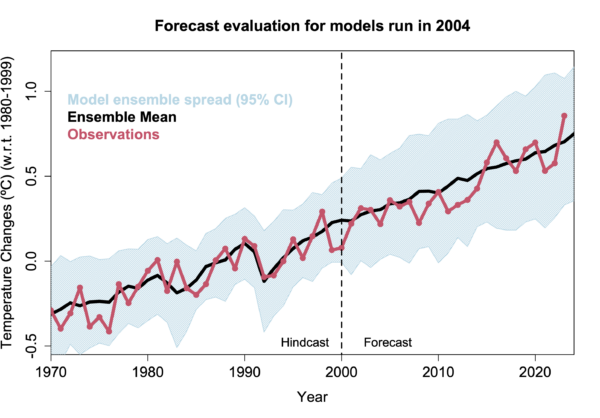
Sabine bases his argument on the result of a single academic paper indicating that the representation of cloud physics in hot models is more accurate than in cooler models.
But those processes are still not properly understood and, e.g., we have a recent result on how model sensitivity can be lowered if certain details of that cloud physics are changed.
I recommend reading the introduction to put a good context to this issue.
https://agupubs.onlinelibrary.wiley.com/doi/10.1029/2023MS003875
And another very interesting question is to understand how the inclusion or not of hot models influences the projections of climate change impacts. One example is this recent study that does this with hydrological projections and finds that it is not clear that the inclusion of hotter models implies projections outside the range of the model ensemble.
https://hess.copernicus.org/articles/27/4355/2023/
The latter brings me to the last part of the video where Sabine describes in some detail the possibility of a disastrous scenario for our way of life. Actually, the possibility of such a scenario is no different than what we already knew. Good climate risk management is about considering that such disastrous scenarios may be unlikely but possible. And that is why we have to make sure (and we know how) that they never happen.
There is an interesting ongoing debate in @kenrice 's blog.
Thanks to @Doug_Bostrom for pointing it out.
https://andthentheresphysics.wordpress.com/2024/01/29/is-the-ecs-very-high/
New post on The Climate Brink by @hausfath@fediscience.org & @andrewdessler@mastodon.world with some comments on Sabine's video.
https://www.theclimatebrink.com/p/revisiting-the-hot-model-problem
Very good analysis by #ClimateAdam on the Sabine's video. Well, he shows clearly than Hossenfelder is not a trustful source on climate science.

Too bad Sabine Hossenfelder spends quite a lot of time on her frequent youtube videos and very little time reading the bibliography. She has responded to the criticism of the video in this thread with a video reply

And she prefers to ignore all the technical arguments and the fact that there is a very good reason for climatologists to be skeptical of high values of climate sensitivity: this review by Sherwood et. al.
https://agupubs.onlinelibrary.wiley.com/doi/10.1029/2019RG000678
⬅️ New projections of global mean sea-level rise to 2500
➡️ Sobre el significado de la base preindustrial