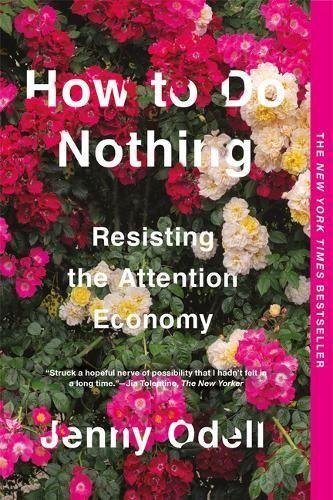
How To Do Nothing: Resisting the Attention Economy
By Jenny Odell
Book notes
“To resist in place is to make oneself into a shape that cannot so easily be appropriated by a capitalist value system.” p.xvi (H2+/-?)
“In chapter 5 ... a view of the self and of identity that is the opposite of the personal brand: an unstable, shapeshifting thing determined by interactions with others and with different kinds of places.” p.xxi-xxii
//
“a subtle frame ... that recognised art that exists where it already is.” p.6
- e.g. Applause Encouraged sunset exhibition
- about creating space to slow down
“the artist creates a structure ... that holds open a contemplative space against the pressures of habit, familiarity, and distraction that constantly threaten to close it.” p.6
“each [space/structure] enact some kind of interruption, a removal from the sphere of familiarity ... they affect the way we see everyday life when we do come back to it.” p.9
- Deep Listening
“that pause in time is often the only thing that can precipitate change on a certain scale.” p.10
//
- Deleuze’s ‘right to say nothing’
“just because this right is denied to many people [due to privilege] doesn’t make it any less of a right or any less important” p.12
- example of 8 hour workday US campaign: ‘eight hours of work, eight hours of rest, and eight hours of what we will’
//
“A public, noncommercial space demands nothing from you in order to enter, nor for you to stay; the most obvious difference between public space and other spaces is that you don’t have to buy anything, or pretend to want to buy something, to be there.” p.13
“spaces seemed commercially unproductive are always under threat, since what they ‘produce’ can’t be measured or exploited or even easily identified [quantitatively]” p.14 ... “I see a similar battle playing out for our time, a colonisation of the self by capitalist ideas of productivity and efficiency. One might say the parks and libraries of the self are always about to be turned into condos [like physical public spaces].” p.14
- the idea we should all be entrepreneurs leads to...
“In a situation where every waking moment has become the time in which we make our living [global digital network] ... time becomes an economic resource that we can no longer justify spending on ‘nothing.’ It provides no return on investment; it is simply too expensive. ... just as we lose noncommercial spaces, we also see all of our own time and our actions as potentially commercial.” p.15
//
“I think that ‘doing nothing’ - in the sense of refusing productivity and stopping to listen - entails an active process of listening that seeks out the effects of racial, environmental, and economic injustice and brings about real change.” p.22
“without them [“spaces for ‘doing nothing’”] we have no way to think, reflect, heal, and sustain ourselves - individually or collectively.” p.22 Thank - repair is self-care, #NOMO (necessity) - connectivity (a share or trigger) vs sensitivity (in-person conversation that takes time)
“[t]he practice of doing nothing ... : an antipode to the rhetoric of growth. In the context of health and ecology, things that grow unchecked are often considered parasitic or cancerous. Yet we inhabit a culture that privileges novelty and growth over the cyclical and regenerative. Our very idea of productivity is premised on the idea of producing something new, whereas we do not tend to see maintenance and care as productive in the same way.” p.25
//
“One [death force (do your own thing)] is routinely valorised, not to mention masculinised, while the other [life force (unification and maintenance of the species)] goes unrecognised because it has no part in ‘progress.’” p.26
//
“I’m suggesting that we protect our spaces and our time for non-instrumental, noncommercial activity and thought, for maintenance, for care, for conviviality.” p.28
CHAPTER 4
“It’s in the realm of poetics that we learn how to encounter.” p.120 (forcing us to look inwards/at serious questions)
“…attention - what we pay attention to and what we do not - renders our reality in a very serious sense.” p.120 (nice long quote on p.121)
Bioregionalism “suggests a way of identifying with place, weaving oneself into a region through observation of and responsibility to the local ecosystem. … a model for community.” p.122-123 (links to indigenous cultures’ relationships to land)
“Realities are, after all, inhabitable. If we can render a new reality together - with attention - perhaps we can meet each other there.” p.126 - designing the future, how it would work
CHAPTER 5
“In a time of increasing climate-related events, those who help you wil likely not be your Twitter followers; they will be your [physical] neighbours.” p.133
“But whether we are the fluid product of our interactions with others is not our choice to make. The only choice is whether to recognize this reality or not.” p.140
“Thought doesn’t occur somehow inside of me, but between what I perceive as me and not-me.” p.142
On learning names of plants/animals/nature: “Eventually, to behold is to become beholden to.” p.145
“Human survival … is beholden not to efficient exploitation but to the maintenance of a delicate web of relationships.” p.148 - about human and nonhuman (environment/ecosystem) relationships + reciprocal attention
“An ecological understanding … reminds us that - while it’s useful to have a word for that thing called a cloud - when we really get down to it, all we can really point to is a series of flows and relationships that sometimes intersect and hold together long enough to be a ‘cloud.’” p.151
“Resisting definition like headwaters resist pinpointing, we emerge from moment to moment, just as our relationships do, our communities do, our politics do.” p.151
“Countless examples from history and ecological science teach us that a diverse community with a complex web of interdependencies is not only richer but more resistant to take over.” p.153 - e.g. Scotland’s sustainable fashion community is diverse and that’s what makes it magical and powerful - a movement
“Bioregionalism teaches us of emergence, interdependence, and the impossibility of absolute boundaries … If we can embrace that [the fact that we are (physically) literally open to the world and (socially) equally determined by our contexts], then we can begin to appreciate our and others’ identities as the emergent and fluid wonders that they are. Most of all, we can open ourselves to those new and previously unimaginable ideas that may arise from our combination, like the lightning that happens between an evanescence cloud and the ever-shifting ground.” p.154
CHAPTER 6
pages 158-159… - good stuff about social media
“Many things in there [her current Twitter feed] seem important, but the sum total is nonsense, and it produces not understanding but a dull and stupefying dread.” p.159 - no context around each tweet
“A 2011 study that boyd conducted with Alice E. Marwick found that Twitter users who had built the most successful personal brands did so by recognizing the fact that they no longer really knew who their audience was.” p.159 - ‘context collapse’ therefore limiting them to “topics that are safe for all possible readers.” - surface level content
Book - No Sense of Place: The Impact of Electronic Media on Social Behaviour by Joshua Meyrowitz, 1985
read Social Media, Immediacy and the Time for Democracy essay by Veronica Barassi (about activists and social media) (pages 164-165)
social media can bring people together “but what made the movement so powerful was the physical space, the process of discussion, and reflection…” p.165
“Without space and time, these dialogues will not only die, they will never be born in the first place.” p.165
“The space of appearance was the seed of democracy, and it was defined by any collection of people who speak and act meaningfully together … [SoA] is an encounter small and concentrated enough that the plurality of its actors is un-collapsed.” p.176 - space for context, we speak to who we intend to speak to, and then can act together - Deep Communication- not Surface Level to make sense to everybody - so often a physical space
“dividing power does not decrease it.” pages 177/178 - causes “coordination action” and “new ideas” due to plurality
“The overwhelming anxiety that I feel in the face of the attention economy doesn’t just have to do with its mechanics and effects, but also with a recognition of, and anguish over, the very real social and environmental injustice that provides the material for that same economy.” p.179
“For me, doing nothing means disengaging from one framework (the attention economy) not only to give myself time to think, but to do something else in another framework.” p.179
“…any attempt at ‘context collection’ will have to deal not only with context collapse online, but with preserving public and open space, as well as the meeting places important to threatened cultures and communities.” p.181
After spending the day in a park rather than at the nearby conference she was supposed to be attending… “Seen from the Point of view of forward-pressing, productive time, this behavior would appear delinquent. I’d look like a drop-out. But from the point of view of the place, I’d look like someone who was finally paying it attention. And from the point of view of myself, the person actually experiencing my life, and to whom I will ultimately answer when I die - I would know that I spent that day on Earth.” p.185
CONCLUSION
“…the resilience and magic I see in the city around me. It is a reminder that no matter how bad things get, they are always changing.” p.187 (quote from T. L. Simons)
“the imagined target of progress. It’s only with her gaze fixed on this target that she can trample on hundreds of species and thousands of years’ worth of knowledge without ever breaking her pallid smile.” p.189 (goal/purpose of a system)
“Our idea of progress is so bound up with the idea of putting something new in the world that it can feel counterintuitive to equate progress with destruction, removal, and remediation.” p.192 (less rather than more)
“Sometimes boycotting the attention economy by withholding attention is the only action we can afford to take. Other times, we can actively look for ways to impact things like (systemic social and environmental issues) … As in any ecology, the fruits of our efforts within any of these fields may welll reach beyond to the others.” p.199 - do what you can
“When we pry open the cracks in the concrete, we stand to encounter life itself” p.204
Finished.
Planted [27 Dec 2020 at 00:04]
Last tended [3 Jan 2022 at 15:51]