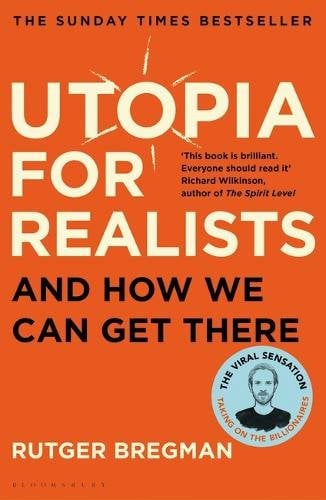
Utopia for Realists: And How We Can Get There
By Rutger Bregman
Book notes
This utopia “offers not solutions but guideposts. Instead of forcing us into a strait-jacket, it inspires us to change. And it understands that, as Voltaire put it, the perfect is the enemy of the good.” p.13
“If a political party or a religious sect had even a fraction of the influence that the advertising is us try has on us and our children, we’d be up in our arms. But because it’s the market, we remain “neutral”.” p.16
Welfare state focuses on symptoms rather than causes of our discontent: the dystopia we are living in today (pp.16-17)
“I’m heartened by our dissatisfaction, because dissatisfaction is a world away from indifference.” p.19
“What we need are alternative horizons that spark the imagination … conflicting utopias are the lifeblood of democracy.” pp.20-22
“‘It is not a finished Utopia that we ought to desire, but a world where imagination and hope are alive and active.’” (Quote by betrand Russell) p.21
“Any further necessary funds can be raised by taxing assets, waste, raw materials, and consumption.” p.43
“‘It’s like teaching a person to swim and then throwing them in a stormy sea,” laments Professor Shafir. p.61 (educating poor people without getting them above poverty line) - mental bandwidth is already too taxed, need to reduce barriers
“people living in unequal societies spend more time worrying about how others see them. This undercuts the quality of relationships (manifested in a distrust of strangers and status anxiety, for example). The resulting stress, in turn, is a major determinant of illness and chronic health problems.” p.66 - relationships project
“Paul Samuelson wrote in his bestselling textbook Economics. “Without measures of economic aggregates like GDP, policymakers would be adrift in a sea of unorganised data,” he continued. “The GDP and related data are like beacons that help policymakers steer the economy toward the key economic objectives.” p.113
“A British think tank estimated that for every pound earned by advertising executives, they destroy and equivalent of £7 in the form of stress, overconsumption, pollution, and debt; conversely, each pound paid to a trash collector creates an equivalent of £12 in terms of health and sustainability.” p.121
“Whereas public sector services often bring a plethora of hidden benefits, the private sector is riddled with hidden costs.” p.121
P.142 [ref 38] for bit about people’s perfect day prioritising intimate relationships and socialising & climate change:
“A worldwide shift to a shorter workweek would cut the CO2 emitted this century by half [ref 39]. Countries with a shorter workweek have a smaller ecological footprint [ref 40]. Consuming less starts with working less - or, better yet, with consuming our prosperity in the form of leisure.” p.142 - does working less mean we consume more or less ? - relationships project
- redistribution of working hours (e.g. to elderly/retirees still wanting to work a bit) p.144
“We may be living in the age of individualism, but our societies have never been more dependent on one another.” p.183 (globalisation)
“The inability to imagine a world in which things are different is evidence only of a poor imagination, not of the impossibility of change.” P.199
“The alternative [to radical inequality] is that at some point during this century, we reject the dogma that you have to work for a living.” p.199
We need “Redristibution of money (basic income), of time (a shorter working week), of taxation (on capital instead of labor), and, of course, of robots. … Technological progress may make a society more prosperous in aggregate, but there’s no economic law that says everyone will benefit.” p.199
“The poorest billion people [in the world] account for just 1% of all consumption; the richest billion, 72%. [ref 26]” p.218
The eight richest people on earth own the same as the poorest half of the whole world (3.5 billion) [ref 29] p.218
How can new ideas defeat old ones? P.239 - sudden shocks can work (disproving old; proving new)
Crisis vs coma
How this relates to Sustainable Fashion Scotland (SFS)
We are about shifting patterns (/creating positive change) rather than resolving problems
consider alternative futures and form new collectives Transcend current “confining zeitgeist” p.20 towards shared visions
Without hope/vision, we are lost
Place where people are connected and collaborating for positive change. Living, thriving, kind system & network
Giving people choice empower them, to make a difference. It enables them Enables/empowers?
Feedback loop of paying for sustainable/circular businesses by taxing waste/punitive for bad practice
P.47 for thoughts on experiments to work towards progress - e.g community calls encourage us to think differently about problems/solutions
Pp. 56-57 on scarcity mindset, and how this prevents us from thinking long-term on things that are also important to us
Help reduce barriers so that our community is able to participate/take action easily (they have enough to worry about already) pp.61-62
Ask circular businesses what support they need most and then get funding for us to provide it to them ?
Hidden benefits of sustainable fashion activity (compared to hidden costs of fast fashion). P.121 Some notes on pp.121-122 about how we can’t govern by numbers because we [humans] excel at experimenting, exploring… read for more!? - ideas for a dashboard with indicators to “track the things that make life worthwhile” P.123 - Quantity and quality of growth - See six conditions of systems change by water fsg
What do we want to grow and for what? - e.g. connectivity / collaborations, supportive networks, space and time to explore new ideas, systems thinking/futures mindsets…, multi-disciplinary relationships, community - Planting seeds metaphor (but not overproduction) - “a society that lives with less” (broader than our mission) - What makes life/fashion worthwhile?
“stable and meaningful work plays a crucial part in every life well lived [ref 50].” p.147
P.170 intervening in education/the classroom to pay dividend for society down the road, when people are most malleable
“Different question… Which knowledge and skills do we want our children to have in 2030? Then, instead of anticipating and adapting, we’d focus on seeing and creating.” p.172
- redistribution of wealth, time…
- Diversity of people/practice (like biodiversity)
- exploitative > ???
Narrative of hope and progress (for our comms strategy) P.258 - speaks to millions of ordinary people
We need to provide energy, ideas, indignation, hope, ethics and “hard sell” p.261
There is a better way to do fashion (see MLP framework; bringing pockets of positive practice into the regime/mainstream and cementing) - create a blog category of inspiring stories, featuring magazine excerpts (library of inspiration/stories of change)
We ORGANISE for change !! - and mobilise the community? - We dare to be unrealistic, unreasonable, and impossible for change/hopeful futures - We are building/nurturing/convening a long term movement - We are Community-led because nobody can create transformative change alone - Building, supporting, resourcing networks of activists that deliver change
https://thinkingdoingchanging.com/2016/01/15/activism-or-clicktivism-or-both/
SFS strategy: our approach - see School’s for learning, is ours ‘organising’? https://thinkingdoingchanging.com/2016/01/15/activism-or-clicktivism-or-both/
- we empower activists/leaders of change
- People are part of a community, not just a movement/issue
Planted [28 Dec 2022 at 20:53]
Last tended [9 Jan 2023 at 13:55]