Hedgerows schedule 📆
- Buy ‘Creating a Forest Garden’
- Propagate ground cover
- Fell conifer
- Mark out paths
- Move plants
- Move circular stepping stones
- Remove & re-use paving
- Make raised beds
- Install arbour
- Build pond
- Create stone pile
- De-turf
- Plant trees
- Sow meadow
- Bark mulch
- Wood chip paths
- Plant big shrubs
- Plant ground cover plants
- Sow temporary ground cover
1. Buy ‘Creating a Forest Garden’
The one book to get. Instruction manual plus a plant reference all-in-one.
2. Propagate ground cover
You’re okay for windbreaks, as the garden seems pretty sheltered but it would be a good time to start propagating your ground cover plants. Plant at a density of about 3-5 plants per square metre:
- Nepalese Raspberry 19m² + 21m² + 10m² = 50m², approx 150 plants
- Ramsons & Ground Ivy 20m², approx 60 plants
- Dwarf Comfrey 15m², approx 45 plants
- Beach Strawberry 22m², approx 66 plants
- Lesser Periwinkle 21m², approx 63 plants
Start with half a dozen of each plant and propagate from there. I can supply most of these.
3. Fell conifer
Make the branches into log piles. Keep the foliage as a temporary ground cover.
4. Mark out paths
Use biodegradeable pale cotton twine and 30cm long bamboo. To save money, buy long lengths of bamboo and cut them to size using loppers.
5. Move plants
I haven’t paid much attention to your existing plants, including the Viburnum bodnantense on the west side of the garden. Before doing any work on paths and beds, best to move all the plants you want to keep, either to another a part of the garden or somewhere temporary if you want to move them back.
6. Move circular stepping stones
I’ve re-used the circular stepping stones in the design, so stack them temporarily somewhere in the meantime.
7. Remove paving
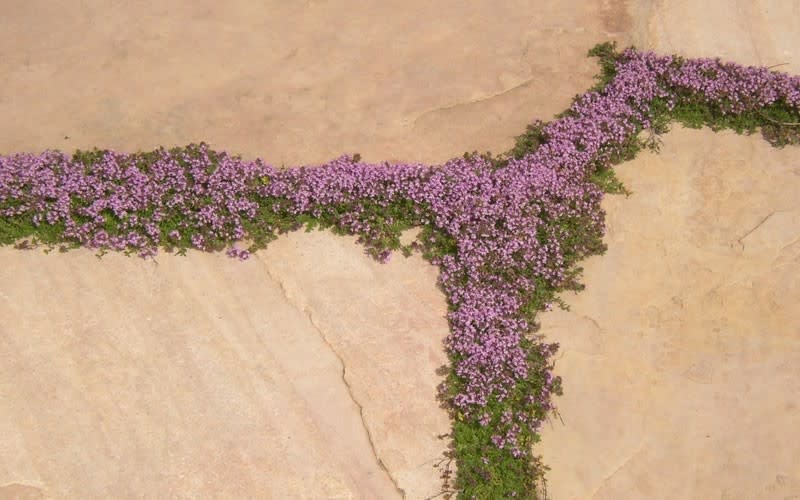
The paving by the conifer needs to be moved before building the raised beds. You can re-use them to make the paths more resilient, and possibly grow Wild Thyme between them.
8. Make raised beds
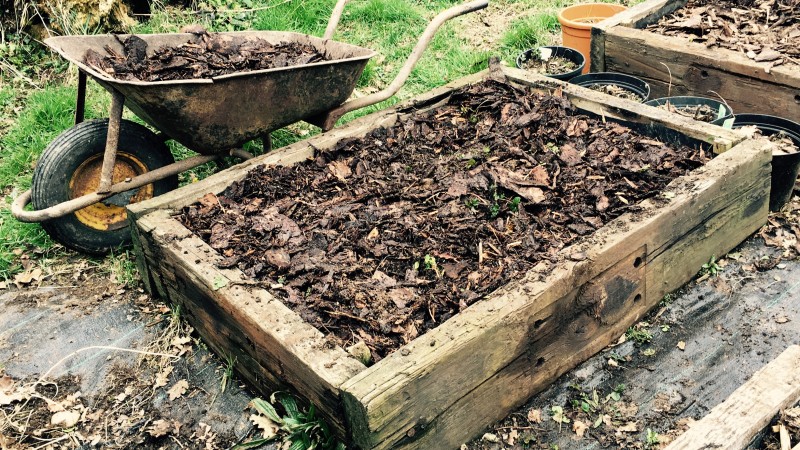
Use split sleepers for the rustic look. Line inside of wood with old plastic sheet to make them last.
9. Install arbour
An arbour would be a great support for a climber like a Hop. You may want to swap the Hop for a Jasmine, as it does have a pungent smell!
10. Build pond
Wildlife ponds are brilliant. For a small pond like this, consider a pre-formed plastic shell. Or an old Belfast sink or other container? Worth getting The Wildlife Pond Book for help.
11. Create stone pile
A stone pile in full sun is a great habitat for wildlife, and a feature in its own right. Local stone/pebbles would be great.
12. De-turf
You have a few options (always mow grass before de-turfing):
- Mulch using large sheets of cardboard (be sure to weigh them down). Old boxes from bicycle shops are ideal. Make sure to take of plastic labels and tape.
- Mulch using woven plastic sheet mulch. Use a decent brand like Phormium or Mypex. I now try to avoid plastic if I can.
- Deturf by hand with a spade. Hard work but doable.
- Hire a deturfing machine.
Don’t deturf all in one go if you don’t have the bark/wood chip mulch and ground cover plants ready. Much better to leave some areas as grass and mow them when you’re ready.
Remember, don’t leave bare soil, it will fill with weeds!
13. Plant trees
- Buy smaller young trees rather than older, larger trees, they’ll get established more quickly and will catch up soon.
- You only need to stake dwarfing rootstocks (like the apple M9 and cherry Gisela) or trees that are 2m high when they’re planted.
- Don’t use fertiliser or enrich the soil.
- Only dig a hole as big as the root ball.
- Wash off the compost from the root ball, will encourage the tree to send out roots.
- Make sure the roots aren’t pot bound (ie in a circle).
14. Sow meadow
There are two areas, one by the pond and across the path in front of the dwarf apple. I would scrape the top layer of top off to reduce the fertility, as meadow wildflowers grow better with a poorer soil. I’d buy a ready made wildflower meadow mix from someone reputable, with some fairly tall, elegant grass seed in the mix. The area is only 3 square metres but I think it would be a lovely addition.
15. Bark mulch
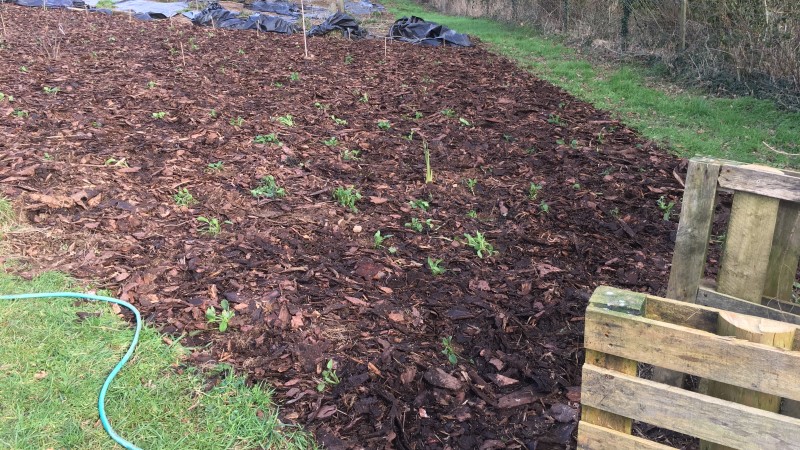
If you can get hold of it from a local saw mill, bark lasts longer as a mulch.
The garden is about 190m². The beds are about 110m². You need about 1-1.5 tonnes for that 110m². Pop it in a big pile on the tarmac by the garage, as it’s much easier to clear up from tarmac than on rough ground.
16. Wood chip paths
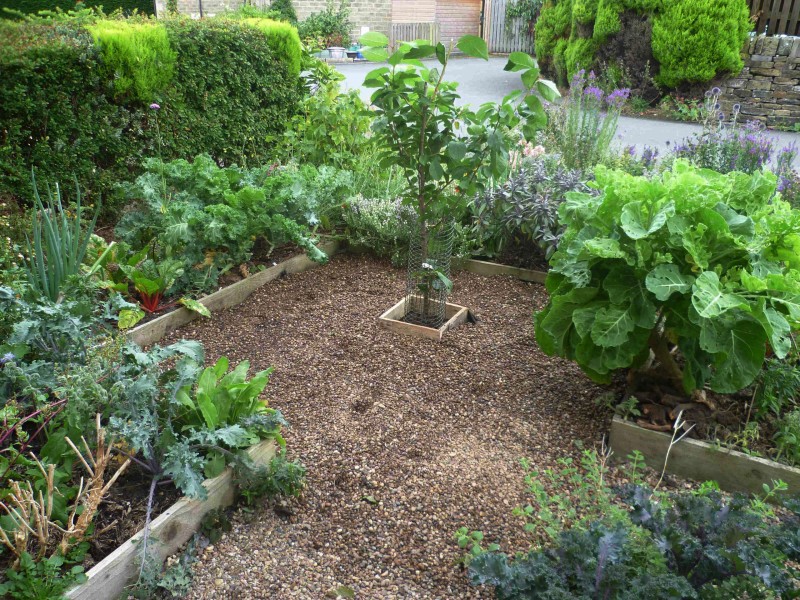
To differentiate the beds from the paths, I would use a wood chip mulch on the paths. A thick layer will be able to swamp out the grass. You do need to top up the mulch every couple of years, so it’s always good to have a little pile around the place. One of the woven 1 tonne bags should be plenty for the area that you have, and a 1 tonne bag will be neater than a pile.
17. Plant big shrubs
I generally like to get the ground covered as soon as possible with the bark mulch, and then plant the shrubs into that. This includes your woody shrubs like the currants and your herbaceous perennials like the ferns and the rhubarb.
18. Plant ground cover plants
Plant into the bark mulch at a density of 3 to 5 plants per square metre. This is why it’s so cost-effective to propagate your own ground cover, as that is a lot of plants!
It will take a couple of years to get a thick living ground cover that suppresses weeds, so there will be extra weeding in that time.
19. Sow temporary ground cover
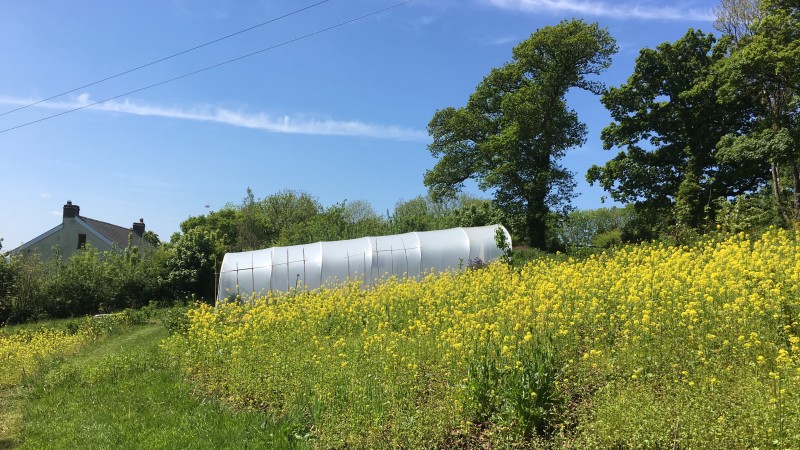
To help the ground cover plants to get established, I sow a temporary ground cover. The one that works for me is White Mustard. You can buy this cheaply from agricultural seed suppliers, handy if you have one locally. You’ll need enough for 110m². Scatter fairly thickly on top of the bark mulch, enough will grow to provide cover for that year.
This page online: http://simp.ly/p/8kYwq5